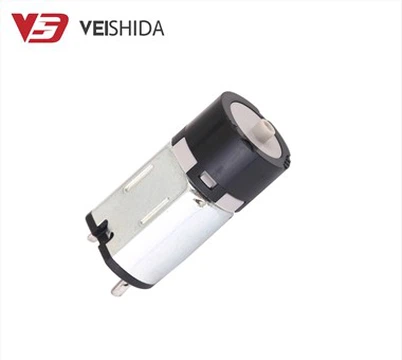




520 Gear Motor
Brand:VSD Motor;
Model:GB37-520SH;
Weishida With 15 years of experience in producing and developing micro-motor / micro-vacuum pumps, we provide flexible and professional customized services.
Description
The brushed 520 gear motor is a common DC motor that is designed based on universal motor principles. This kind of motor consists of a fixed part and a rotating part, and the rotating force is generated through electromagnetic induction between the two parts. Especially suitable for applications requiring high performance and efficiency. Used with a 37mm gearbox, the gear system can change its torque and speed through reduction ratio. It is a brushed motor, so maintenance costs are relatively low as the brushes can be easily replaced. This kind of motor also has the advantages of high precision, smooth operation, high speed and high starting torque. The voltage, speed, reduction ratio, torque and other properties of the reduction motor can be customized according to customer requirements.

This is a motor commonly used in small electric equipment such as electric toys, models, and ornaments. It uses DC power supply and is simple and easy to use. In a motor, there is a set of stators and a set of rotors. The stator surrounds the rotor. When the motor is started, the electric energy provided by the power supply generates a magnetic field, causing an interactive force between the stator and the rotor to drive the rotor. However, continuous operation of a DC motor for a long time will generate heat and friction, but These problems can be effectively controlled using the appropriate devices to ensure normal service life and performance of the motor.

The core components of JGB37-520 Motor include motor shaft, metal gear, motor housing, motor end cover, spring, etc. When the motor is energized, a magnetic field is created inside the stator, which attracts the rotor and causes it to start spinning. At the same time, the metal gear meshes with the rotor, further increasing the speed.

During the working process of the DC 12V Motor, the interaction between the stator and the rotor will cause the motor to generate friction and heat. If not controlled, it will affect the life and safety of the motor. Therefore, inside the motor, there are usually devices such as motor end covers and springs to absorb shock and adjust the speed.

Self-locking - the worm gear motor has self-locking properties, that is, the output shaft cannot rotate when the motor is powered off.
Easy to use - the DC reduction motor with worm can change the rotation direction of the 520 Gear Motor by changing the wiring method, making it more flexible to use.
Output shaft - the output shaft direction of the reduction motor is perpendicular to the motor shaft, and the output shaft direction of the entire motor body is shorter than that of an ordinary reduction motor.
Application - GB37-520 DC motor is widely used in window openers, door openers, automatic doors, toy motors, micro winches, etc.
All-metal gear - pure copper core rotor, galvanized, with strong load-bearing capacity and effective protection of the motor body.

1. Shaft material selection
Choosing the right shaft material is very important as it directly affects the performance and life of the motor. Typically, shaft material selection considers the following aspects: stiffness, wear resistance, and corrosion resistance. Commonly used shaft materials include stainless steel, hard aluminum alloy and other materials.
2. Axis accuracy requirements
Before processing, the accuracy of the shaft needs to be required. This is because the accuracy requirements of the shaft will affect the performance and life of the motor. Common shaft accuracy requirements include diameter tolerance, shaft core deviation, roundness tolerance, etc.
3. Determine the processing method of the shaft
Before processing the shaft, it is necessary to determine the processing method of the shaft. Normally, CNC lathes and other equipment are used for processing. During this process, attention needs to be paid to the processing accuracy and surface quality.
4. Smooth processing
During processing, attention needs to be paid to the smoothness of the shaft surface. If the shaft surface is not smooth, it will affect the performance and life of the 12V motor. Therefore, appropriate cutting tools and lubricants need to be used during shaft machining to ensure the smoothness of the shaft surface.
5. Inspection and debugging
After the machining of the shaft is completed, inspection and debugging work is required. Inspection can determine the accuracy of the shaft through physical measurements, and commissioning can verify the performance of the shaft through testing. If the shaft processing is found to be unqualified, it needs to be reprocessed.
Send Inquiry
You Might Also Like