


What is a Coreless Motor
A Coreless Motor, also known as: an Ironless Motor, differs from a conventional motor by having a rotor with a Coreless-shaped winding without an iron core. This novel fixed rotor design makes the motor more flexible in rotation, and effectively reduces iron loss and eddy current loss.
Types of Coreless Motor
There are mainly two types of "Coreless Brushed DC Motor" and "Coreless Brushless DC Motor (BLDC)" :
Coreless Brushed DC Motor : with a brush and commutator to switch the direction of current, the structure is relatively simple, low cost, suitable for some applications with relatively low precision and life requirements, but with wear will require more frequent maintenance.
Coreless Brushless DC Motor: The motor uses an electronic control circuit to switch the current direction of the windings, avoids the friction problem of the brushed motor, has a longer service life and higher efficiency, and is suitable for equipment that needs to operate for a long time.
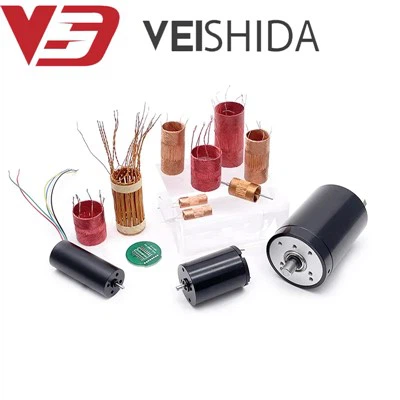
The products of the Coreless Motor owned by VSD are as follows:


How to make a Coreless DC Motor
Core parts
Before understanding how to make the Coreless DC Motor, we must first understand its core components, we take the Coreless Brushed DC Motor as an example:
Coreless winding: made of coreless copper wire wound cup shape, light weight, little inertia.
Commutator and brush: switch the direction of current through mechanical contact, so that the motor can run continuously.
Magnets: Usually use rare earth permanent magnet materials, such as NdFeB, to provide a strong magnetic field.
Bearings and rotors: Ensure stability and low friction when the motor rotates.
Housing: Protects the internal structure and provides a position for fixed installation.
The Coreless BLDC Motor eliminates the structure of carbon brush and commutator on the basis of the Coreless Brushed DC Motor, and the current conversion is realized by a control drive plate. The Coreless winding is fixed on the annular iron core inside the casing by means of bonding.
Compared with conventional brushless motors where the copper wire is wound around the core pole, the copper wire of the Coreless BLDC Motor is made of self-adhesive enamelled wire (the coil can be bonded to form after heating or solvent treatment) without a winding core, which reduces eddy current losses. The efficiency of the Coreless BLDC Motor could be as high as 80%-90%, while the efficiency of the conventional brushless DC motor was only about 60%.
Making a Coreless Brushed DC Motor usually follows the following steps:
1. Making windings: coreless copper wire is wound to make cup-shaped coils by automated equipment, this step needs to ensure that the winding is uniform and accurate.
2. Install the permanent magnets: Fix the high strength permanent magnet inside the stator to ensure the magnetic coupling with the Coreless winding.
3. Install the commutator and brush: the commutator is installed on the winding shaft, and the brush is fixed in the housing of the motor, so that they can contact the commutator to switch the current direction.
4. Assembly bearing and rotor: the bearing is connected to the rotor to ensure the low friction and efficient operation of the entire rotating mechanism.
5. Packaging and testing: After completing the assembly of all components, electrical performance and mechanical stability tests are carried out to ensure that the performance indicators of the motor meet the requirements.
Coreless Motor Design
The design of Coreless Motor mainly has three kinds of winding structure: straight wound, inclined wound and concentric winding, each structure has its own advantages, suitable for different application needs.
Straight wound: In this design, the wire is wound in a straight line parallel to the axis of the motor. This is simple in structure and low in manufacturing cost, suitable for applications requiring low cost and moderate performance, but the magnetic coupling efficiency is low, and the output power of the motor is relatively small.
Oblique winding: The wire is wound diagonally at a certain angle, and the density and coverage of the winding is higher than that of the straight winding. This design improves the magnetic coupling efficiency of the motor, reduces vibration and noise, makes the motor run more smoothly, and is suitable for applications requiring higher performance and lower noise.
Concentric winding: The wire is wound in concentric circles on the Coreless, providing a uniform magnetic field distribution and high efficiency. This design is usually used in equipment requiring extremely high precision, lower inertia of the motor, fast response, and is suitable for precision controlled applications such as medical equipment and robotics.
How does a Coreless motor work
The working principle of the Coreless Motor is based on the law of electromagnetic induction.When an electric current flows through the winding of a Coreless Motor, the current in the winding interacts with the motor's magnetic field, creating an electromagnetic force that drives the rotor to rotate. Unlike cored motors, Coreless Motors do not have an iron core, so hysteresis and eddy current losses brought about by the iron core are eliminated, and the rotor inertia of the motor is very low. This feature allows the Coreless Motor to respond quickly to external control signals, and has less inertia when starting and stopping, so it is very suitable for high-precision and high-dynamic response applications.
Coreless Motor vs Core Motor
Advantages of Coreless Motor compared with core motor:
Lower rotor inertia: Because the rotor of the Coreless Motor has no iron core, the weight of the rotor is lighter and the inertia is lower. This makes it more responsive during acceleration and deceleration, making it ideal for products that require fast response and precise positioning, such as robots and precision instruments.
High efficiency and low loss: Because there is no iron core problem, the Coreless Motor does not produce core losses (such as eddy current and hysteresis losses), which makes the energy conversion efficiency of the motor higher, in normal circumstances, energy utilization can reach 75%-90%.
Smooth operation and low noise: The design of the Coreless Motor reduces the vibration and noise caused by the iron core, making the motor more stable and quiet when running. Under the brushless DC motor with the same parameters, the Coreless BLDC Motor is more suitable for noise-sensitive occasions, such as medical equipment and high-end consumer electronics.
Smooth operation and low noise: The design of the Coreless Motor reduces the vibration and noise caused by the iron core, making the motor more stable and quiet when running. Under the brushless DC motor with the same parameters, the Coreless BLDC Motor is more suitable for noise-sensitive occasions, such as medical equipment and high-end consumer electronics.
Compact construction: Coreless Motors are usually compact in design and can be used in applications where volume and weight restrictions are strict. Because there is no iron core, the motor can achieve a higher output power in a smaller space, suitable for portable devices and areas requiring lightweight.
Good heat dissipation performance: Coreless Motor because there is no iron core, its internal gap can be better for air flow and heat dissipation. Compared with the core motor, it can deal with the heat generated during work more effectively, reduce the speed of the motor temperature rise, thus extending the service life.
The disadvantages of Coreless Motor compared with core motor:
The manufacturing cost is relatively high: the production process of the Coreless Motor is relatively complex, and the manufacturing material cost is also high, which makes its overall production cost higher than that of the core motor, so it does not have a cost advantage in some applications.
The manufacturing process is more complex: the manufacturing of Coreless Motors requires precise processes and more complex equipment, especially the processing of winding and stator, which makes the production process more difficult and limits the speed of mass production.
More sensitive to temperature: the Coreless Motor is usually not supported by an iron core, which makes its winding part more sensitive to high temperatures. If the motor is operating at too high a temperature, the windings may overheat and cause performance degradation or damage.
Magnetic material limitation and magnetic flux density limitation: Due to the structural design of the Coreless Motor, it produces a relatively low magnetic field and magnetic flux density, which may limit the output power of the motor in some applications. In addition, Coreless Motors have a strong dependence on magnetic materials, so in applications requiring high performance, the motor may need to use more expensive magnetic materials.
Why was VSD's Coreless Motor chosen
Founded in 2011 as China's leading Coreless Motor manufacturer, VSD focuses on the research and development, manufacture and marketing of high-performance micromotors. Covering an area of more than 10,000 square meters, the VSD plant has more than 500 front-line employees and more than 100 managerial staff, among which the research and development team consists of 25 experts. We produce more than 4.5 million units of motors per month, ensuring adequate supply and customized solutions for customers worldwide.
Our motor products are widely used in the fields of medical equipment, smart home, beauty and health, vehicle systems, model aircraft, electronic office supplies, banking equipment and communication equipment. As a professional supplier of Coreless Motor suppliers, we ensure product quality and innovation speed through introducing high-end R & D equipment and advanced production management concept. VSD launches a new motor every two months to meet the market demand for high efficiency and customization.
Our motors have been exported to Europe, America and Southeast Asia, and won the trust and praise of international well-known enterprises such as Mengfali, Panasonic and Philips. Choosing VSD means choosing the excellence of Coreless Motor technology and globally recognized quality.