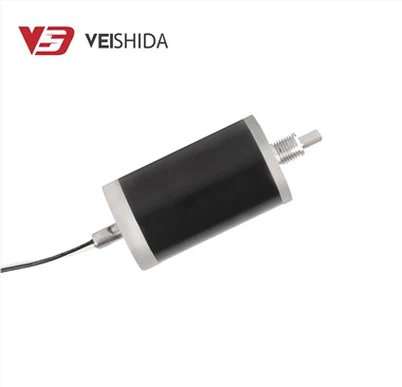


Brushless Motor for Medical Infusion Pump: How to Size
Leave a message
An infusion pump fails in two ways, and both trace back to the motor rather than the pump head. The flow drifts, or the occlusion alarm arrives late because the drive cannot tell that the line has closed. One is a resolution problem, the other is a torque problem, and both are settled at the point where the frame and the winding are chosen.
What the pump actually asks of the motor
A peristaltic head compresses a tube between rollers, so the motor sees a load that rises and falls once per roller pass. The head turns slowly, usually somewhere between 8 and 120 rpm depending on tube bore and the flow rate you are targeting, which means the motor almost always sits behind a reduction stage. What matters at the motor shaft is that the speed stays constant while the load pulses, because a head that slows on the compression stroke delivers a smaller bolus than the one you calculated.
A syringe pump is the opposite shape of problem. The lead screw turns fast relative to the travel, the load is nearly constant, and accuracy comes from counting steps rather than from holding speed. Here the enemy is backlash and any lost motion between motor, coupling and screw, not the torque curve.
Both types share one requirement people forget until validation: the drive has to break away from standstill against a closed line. A pump that cannot start under occlusion will report the alarm, but it reports it after the motor has stalled, and the volume delivered in that window is the number the test house asks about.
The four numbers that set the frame
Speed at the roller, never at the motor
Start from the head and work backwards. Our 24 V VBL-3659 is rated 2,343 rpm at 22.998 mN.m; behind a 50:1 planetary stage that becomes roughly 47 rpm at the head with about 1.1 N.m available before gearbox losses. If your target is 20 mL/h through a 3.2 mm bore, that is the arithmetic to run, and it usually lands you between 30:1 and 80:1 rather than at a round number.
Starting torque is the occlusion specification
Read the starting torque on the datasheet, not the rated torque. The same VBL-3659 starts at 116.799 mN.m while drawing 1.514 A, against a rated 22.998 mN.m at 0.371 A, so the breakaway margin is about five times the running load. That margin is what lets a controller detect a closed line by watching current rise before the shaft stops, instead of after.
Ripple shows up as flow error
A brushless motor driven six-step produces torque in six increments per electrical revolution. At 47 rpm output that is invisible; at 8 rpm it is not, and on a peristaltic head the roller pass and the commutation ripple can beat against each other. If your flow tolerance is tight at the low end, specify sine commutation and ask for the encoder option at the quoting stage, because the winding and the sensor package are fixed together.
Duty decides whether you need brushless at all
A pump that runs continuously in a ward accumulates thousands of hours a year, and a brushed motor turns that into a maintenance interval plus carbon dust inside a housing that is meant to stay sealed. Brushless costs more at the bill of materials and removes both problems. For a bench instrument that runs an hour a day, the brushed version is still the cheaper answer and we will say so.
Frames that fit this axis
| Frame | Rated point | Starting torque | Where it goes |
|---|---|---|---|
| VBL-3659, 24 V | 2,343 rpm, 22.998 mN.m, 5.642 W, 0.371 A | 116.799 mN.m at 1.514 A | main peristaltic drive, occlusion detection by current |
| VBL-2833DI, 28 mm | 19,827 rpm, 12.828 mN.m, 26.635 W at 24 V | 70.993 mN.m at 7.607 A | syringe lead screw through a high ratio stage |
| VBL-2238DI, 22 mm | 4,242 rpm, 4.431 mN.m, 1.969 W at 24 V | 19.84 mN.m at 0.496 A | valve and pressure-sensor actuation inside the pump |
The two smaller frames are built as standard 12 V and 24 V windings, so a design that has to work from a battery pack and from a mains adapter can use the same mechanical envelope with two windings. The brushless DC motor range runs from 16 mm to 37 mm, and the same six frames carry the Hall board and the driver interface your board already expects.
Certification and what a quote needs
The plant holds ISO9001:2015 and IATF16949, and the IATF certificate dates from 2014; the frame designs sit behind 51 patents. We build motors to drawing, not medical devices, so the regulatory file on the pump stays with you, and we supply the component declaration and test report you need inside it. Certification documents are published on the company certificate page rather than sent as a scanned image, so the numbers can be checked before they go into your file.
Customisation covers the winding, the shaft and its flat or keyway, lead length and connector, the mounting face and the Hall or encoder package. Standard builds start at 1,000 units; below that we quote per project and run a sample before any batch is committed, which for a pump usually means a flow-repeatability run on your head rather than a bench number from ours.
Questions engineers ask about infusion pump motors
Should a pump motor be brushless or brushed?
Brushless if the pump runs more than a few hundred hours a year, because there is no brush to replace and no carbon dust inside a sealed housing. Brushed remains cheaper for intermittent bench instruments. The crossover is duty, not flow rate.
How do I choose the gearbox ratio?
Take head speed first: 2,343 rpm divided by your roller rpm gives the ratio. Then check that the resulting output torque, after allowing for stage efficiency, still exceeds the occlusion breakaway by a comfortable margin. If it does not, go up a frame rather than up a ratio.
Can one motor run from 12 V and 24 V?
Not the same winding. The VBL-2238DI is built in a 12 V version with 5,236 rpm no-load and a 24 V version with 5,462 rpm, and each has its own operating window. Two windings in one mechanical envelope is the usual answer for dual-supply designs.
Do you supply medical-certified motors?
We supply components built under ISO9001:2015 and IATF16949, with the declarations your device file needs. We do not hold a medical device certification and do not claim one; the pump's approval stays with the device manufacturer. Ask for the material and test reports per part number and they ship with the sample.
What do you need to quote?
Head speed, the torque needed to break occlusion, supply voltage, available envelope, duty cycle and annual volume. Those six narrow the range to two frames, and the quote names the winding, shaft and lead length so a sample can start from a fixed drawing.
Send the head speed, the occlusion torque you must break and the supply you have, and our engineering team will shortlist two frames with the gearbox ratio for each, normally within 24 hours.