

FPV Drones: How Fast, How Far, and Can They Hover
Leave a message
How Fast Can an FPV Drone Fly
There is no unified answer to the question "How fast can an FPV drone fly?" because the speed of an FPV drone is affected by many factors, including the motor KV value, propeller efficiency, battery platform, fuselage structure design, etc. Let's take a look at the speed performance of several common FPV drones:
Consumer FPV Drone Speeds
|
type |
Frame Size |
Normal speed range |
Features |
|
3 inch flying drone |
100–150mm |
About 80–100 km/h |
Compact and flexible, suitable for urban travel and indoor flight |
|
5-inch flying drone |
200–250mm |
Up to 120–160 km/h |
The most common entry-level to advanced FPV racing models |
|
High-End Racing Drone |
High performance custom configuration |
Over 200 km/h |
For example, the FPV drone developed by Dutch Drone Gods and Red Bull has a rotation speed of up to 42,000 rpm, can accelerate to 300 km/h in 4 seconds, and has a top speed exceeding 350 km/h, representing the upper limit of current FPV racing performance." |
Military FPV Drone Speeds
|
model |
Estimated speed range |
Features |
|
Russian military "Key" FPV drone |
About 100–120 km/h |
Highly mobile tactical platform, suitable for assault and delivery missions |
|
Ukrainian "Werewolf" FPV |
Up to 200 km/h |
Strong power output, derived from high thrust-to-weight ratio motor and optimized fuselage |
What factors affect the speed of FPV drones?
1. Motor KV Rating and Overall Design
High KV value (such as 2306/2400KV) can provide higher speed, suitable for racing and crossing;
A higher thrust-to-weight ratio translates to faster acceleration and stronger burst performance.
2. Propeller specifications and matching
The size, material and pitch of the propeller directly determine the air pushing efficiency;
High-pitch propellers are better for racing, while low-pitch ones provide more stability.
3. Battery Setup and Discharge Performance
4S/6S is a common configuration. High voltage combined with high C number can bring explosive performance.
Battery selection must also take into account flight time and balance.
4. Aerodynamic design of the fuselage
A more streamlined structure means less air resistance.
Giving equal emphasis to lightness and rigidity is the key design logic for improving speed.
For ordinary players, a 5-inch FPV drone can already provide a very shocking speed experience (120-160 km/h); and in high-end competitive or military platforms, flight speeds of 300+ km/h have become a reality. However, behind such speed, it is inevitable that a set of well-matched high-performance motors and power system support are indispensable.

Can an FPV drone hover
The answer is: Technically possible, but not typical or practical.
Compared with the automatic hovering function common in aerial photography drones (such as the GPS positioning system equipped by brands such as DJI), FPV drones usually do not have the "automatic hovering" function. FPV drones typically operate in full manual "Acro" mode, requiring constant pilot input to maintain stability.
Why are FPV drones not good at hovering?
1. No GPS positioning assistance
Most FPV drones are not connected to GPS, which means they cannot remain stationary in the air through a "position lock".
This type of aircraft pursues flexibility and response speed rather than stable air retention.
2. The flight control mode tends to be more free and more sensitive
FPV flight control settings are usually based on Acro (Acrobatic) mode, emphasizing full manual control;
Lacking functions such as automatic horizontal calibration and automatic balance, pilots need to constantly fine-tune their posture to barely maintain "fixed-point flight".
3. They are more susceptible to wind and environmental disturbances.
FPV drones are lightweight and easily disturbed in windy environments;
Lacking the assistance of multiple sensors (such as barometer, compass, and visual positioning), it is naturally impossible to hover stably like an aerial photography drone.
Is it possible to achieve FPV hovering?
Yes - if you meet one of the following conditions:
Equipped with GPS module and automatic balancing flight control mode (Angle/Horizon);
With high pilot skills, manual maintenance can be performed without assistance;
Or use a hybrid flight control (such as iNAV, BetaFlight plus peripheral modules) to achieve simple positioning and altitude setting.
However, most FPV players do not pursue such functions, but prefer flying experiences such as dynamic shooting, racing flying, and crossing obstacles.
FPV drones can "do it" in terms of hovering, but that is not its strong point. If you are looking for automatic stabilization and fixed-point shooting functions, aerial photography drones will be a more suitable choice; and if you prefer speed and control fun, then embrace the free flight mode of FPV.

How far can an FPV drone fly
"How far can an FPV drone fly?" The answer to this question is related to the technical limit of the signal link, as well as the battery life and the pilot's flying style.
The maximum communication range is determined by the image transmission and remote control system
1. Analog
Using the 5.8GHz frequency band, it has weak anti-interference ability and poor penetration ability;
Usually suitable for a flight distance of 1~2 kilometers. In cities or forests with more interference, the distance may be even shorter.
The advantage is extremely low latency, which is suitable for racing scenarios.
2. Digital image transmission
Representative systems: DJI FPV, HDZero, Walksnail Avatar;
Thanks to image coding technology and intelligent frequency modulation, it can support 4~10 km transmission in an open environment;
The images are clearer, making them ideal for long-distance exploration and immersive flight.
3. Remote control communication protocol
Standard 2.4GHz controller: about 1~2km;
Advanced protocols such as ELRS (ExpressLRS), TBS Crossfire, and Ghost, combined with the 900MHz/868MHz frequency band, can theoretically reach 10~20km;
Longer distances rely more on stable antenna installation, interference management, and frequency planning .
Battery life ultimately limits the actual flight distance
Although the signal link may support more than 10 kilometers, the endurance performance of FPV drones is often lagging behind:
Ordinary 5-inch drones (such as those equipped with 4S/1300mAh batteries) can only last about 3 to 5 minutes in intense flight.
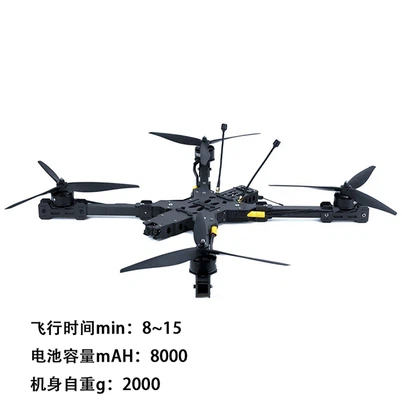
High-performance drones (such as those equipped with 6S/2200mAh batteries and low-KV motors and large propellers) can fly for 8 to 12 minutes;
The extreme long-range models (such as LR4 and Explorer LR) use low-KV high-efficiency motors, long propellers, and light-load design, and the actual flight distance can exceed 10 kilometers.

How much does an FPV drone cost
The price of FPV drones varies greatly depending on the configuration, brand, size, image transmission system, motor performance and flight control platform. There are options available from entry-level kits to professional racing drones, with prices ranging from a few hundred to several thousand dollars.
Entry level: $280 ~ $430 (about 2000 ~ 3000 yuan)
Suitable for beginners to experience FPV flying. This type of drone generally has basic flight capabilities and image transmission functions, and is suitable for indoor or small field practice:
Most of them use small-sized frames (such as 2-inch and 3-inch), which are light in weight and moderate in power;
Analog image transmission system or basic digital image transmission, with lower resolution but less latency;
Most of them are sets (including remote control, glasses, batteries, etc.).
Applicable people: Beginners who are new to FPV and aim to learn flight control and experience first-person perspective flying.
Mid-range: $430 ~ $720 (about 3,000 ~ 5,000 yuan)
Suitable for players who have a certain level of flying experience and pursue a smoother flight experience and clearer image quality. This level of drone has significantly improved speed, stability and image transmission quality:
Adopt 5-inch mainstream frame and equipped with high-performance brushless motor;
Support digital image transmission systems (such as DJI O3, Walksnail Avatar);
Flight controllers are usually equipped with a GPS module and multiple flight modes;
You can mount a GoPro or use a high-resolution camera for HD video recording;
The ESC and battery platform are more stable, and the battery life can generally reach 6 to 10 minutes.
Applicable people: Advanced players who have higher requirements for flight feel and image quality. Suitable for outdoor travel, Vlog aerial photography and other scenes.
High-end: $720+ (more than 5,000 yuan, or even more)
Professional FPV drones are usually hand-made or high-end complete products, and are widely used in racing competitions, film and television aerial photography, long-distance missions or special flight missions:
Equipped with high KV value power motor and high current ESC;
Lightweight carbon fiber frame, low-interference circuit layout, high-performance flight control (supports black box, GPS return, etc.);
Image transmission uses O3 Air Unit, HDZero or DJI FPV system;
Equipped with high-definition recording equipment such as GoPro Hero 11 and DJI Action 4;
The battery platform is mostly 6S 1800mAh or higher, taking both battery life and power into consideration;
The flight control supports multi-protocol control (such as ELRS, Crossfire) to achieve long-distance control.
Applicable people: professional pilots, film and television shooting teams, high-intensity task operators, who have extremely high requirements for performance and stability.

How to improve flight performance
The flight performance of FPV drones is mainly reflected in speed, control sensitivity, endurance and stability. These indicators are directly subject to the power system, battery, electric speed controller and fuselage design. If you want to make the drone fly faster, more stable and longer, you can start from the following aspects:
1. Upgrade the motor power system
Choose a high-response motor: A brushless motor with fast response speed and high thrust-to-weight ratio (such as the 2207 and 2306 series) can release greater acceleration force in a short period of time.
Optimize KV value matching: high KV motors are suitable for racing and crossing, while low KV motors are suitable for stable and long-distance flight.
Ensure a reasonable thrust-to-weight ratio: The ideal thrust-to-weight ratio is maintained at around 5:1. A high-load platform requires a larger thrust motor.
2. ESC and battery upgrade
Select a high-current ESC that matches the motor, and leave 20~30% current margin to avoid speed drops in extreme conditions.
Improve battery performance: Batteries with higher capacity and higher discharge rate (C number) can provide stronger power and longer battery life at the same time.
For long-range aircraft, consider using high-energy-density Li-ion batteries to significantly extend flight time.
3. Reduce fuselage weight and optimize aerodynamics
Lightweight frame: Carbon fiber frame and streamlined cable layout help reduce energy consumption;
Reduce wind resistance: Streamlined fuselage and reasonable blade layout can improve flight efficiency.
Propeller upgrade: Choose high-efficiency propellers or silent propellers to improve thrust output and noise control.
4. Reasonably adjust flight control parameters
Use appropriate PID tuning and flight mode to improve flight stability and control experience;
Use black box data to perform tuning to optimize vibration and energy consumption.
5. Daily maintenance is essential
Keep motor bearings clean and lubricated to reduce mechanical losses;
Check the battery internal resistance and ESC temperature to avoid performance degradation.
The improvement of FPV drone performance is not achieved by a single component, but by the overall coordinated optimization of the motor, ESC, battery and frame. If you want both speed and stability, high-quality motors and efficient power systems are undoubtedly the most critical investments.

The key to performance improvement lies in the power system
The charm of FPV drones comes from the speed, flexibility and immersion they bring. All these experiences are ultimately determined by the power system - the coordinated work of the motor, electronic speed controller (ESC), battery and propellers determines the ultimate performance of the drone.
When optimizing the FPV flight experience, high-quality motors are always the core investment. They not only provide more stable thrust and faster response, but also maintain reliability under high load and long-term flight. For racing aircraft, choosing high-KV, high-response motors is the key to unleashing speed potential; while for long-range and aerial photography missions, low-KV, high-efficiency motors can better balance endurance and stability.