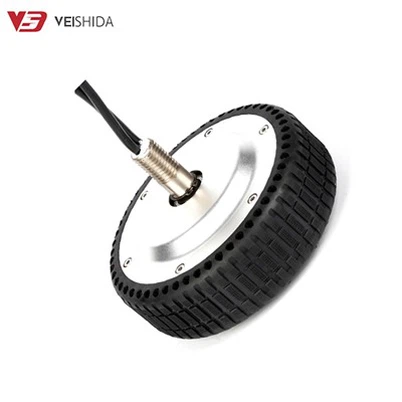


The working principle of motor commutator
Leave a message
The motor commutator, also known as a rectifier, is an important part of the motor armature, a component that allows the motor to rotate continuously. So how does the commutator function? We will introduce it to you today.

A number of contact strips fixed to the rotating shaft of the motor and connected to the armature winding make up the motor commutator. As the shaft rotates, the commutator reverses the current in the winding. When the shaft is halfway rotated, the windings of a single armature are now connected so that current now flows through it in the opposite direction from the initial direction. The rotational force or torque of the rotating motor on the winding is generated by the armature current acting on a fixed magnetic field. The mechanical torque applied to the shaft by the power source maintains the motion of the armature winding through the fixed magnetic field, thereby inducing a current in the winding. In the case of motors and generators, the commutator periodically reverses the direction of the current flowing through the windings so that the current in the motor's external circuit continues to flow in only one direction. In other words, when the coil passes through the current, it rotates under the action of the permanent magnet generating attractive and repulsive forces. When it rotates to balance with the magnet, the original energized circuit is separated from the brushes corresponding to the contact pieces on the commutator, and the brushes are connected to the contact pieces corresponding to the coil set that satisfies the force generating propulsion, and this is repeated over and over again, and the DC motor turns.

The above is the working principle of motor commutator, more related information welcome to consult us at any time