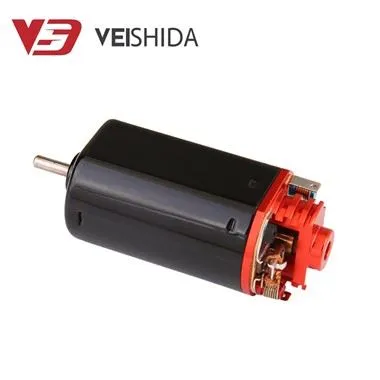


What Is a Hollow Cup Motor and What Coreless Construction Buys You
Leave a message
A hollow cup motor is a DC motor whose rotor carries no iron: the windings are wound into a self-supporting cup that spins in the air gap between the magnets. Removing the iron removes hysteresis loss, cogging and most of the rotor inertia, which is why these motors reach a commanded speed in milliseconds and stop just as fast. The price is torque density and heat path, and that trade is what the rest of this page is about.
What a hollow cup motor actually is
In a conventional DC motor the rotor is a stack of laminated steel teeth with copper wound around them. The steel carries the magnetic flux, and it is the reason the motor produces useful torque from a small frame. It is also the reason the rotor is heavy, and the reason torque varies in steps as the teeth pass the magnets.
A hollow cup motor deletes that stack. The winding is wound on a mandrel, bonded so it holds its own shape, and the mandrel is pulled out. What is left is a thin cup of copper sitting in the gap, with the magnets outside it and the shaft bonded to the cup end. The name comes from the shape; the industry also calls them coreless or ironless motors, and the three terms describe the same construction.
Because there is no steel in the rotor, there is nothing to magnetise and demagnetise on every revolution. That single change is responsible for most of what follows, and it is also why a hollow cup motor has to be sized differently from a slotted one.
What the missing iron core changes
No hysteresis loss, so speed and torque stay flat
Every time the rotor turns, iron in a slotted rotor is magnetised in one direction and then the other. That cycling costs energy as heat, and it is why the no-load current of a slotted motor climbs as speed rises. An ironless rotor has no such loss, so the speed-torque line stays closer to a straight line and the motor holds a commanded speed without the small ripple that comes from tooth-to-tooth variation.
No cogging, so the shaft can stop anywhere
Slotted motors have preferred rest positions: the rotor wants to snap to the nearest tooth. That is cogging torque, and in a positioning job it shows up as a limit on how finely the shaft can be placed. With no teeth there is nothing to snap to, so a hollow cup motor glides to a stop wherever the controller puts it.
Low rotor inertia, so acceleration is quick
The copper cup weighs a fraction of a laminated stack of the same diameter. Lower inertia means less torque is spent accelerating the rotor itself, which matters in any application that starts and stops repeatedly: a handpiece, a gimbal correction, a syringe drive indexing forward. It is also why these motors are used where the load is small but the cycle rate is high.
No radial magnetic pull on the rotor
In a slotted motor the rotor and stator pull on each other across the air gap, and that radial force is carried by the bearings. An ironless rotor sits in a more symmetric field, so the side load on the bearings is smaller and the shaft runs quieter at speed. For a motor that has to run for hours in a handheld device, that is a bearing life argument as much as a noise argument.
What it costs you
The iron in a slotted rotor is a flux path, and without it the same frame produces less torque per ampere. To recover torque you either lengthen the cup, widen the diameter, or accept more current. All three have consequences: a longer cup needs a longer housing, a wider one needs a wider envelope, and more current means more heat in a winding that has no steel to conduct it away.
Heat is the real constraint. In a slotted motor the iron carries heat from the winding into the housing. In a hollow cup motor the winding is surrounded by air, so the path is shorter but thinner, and the winding runs hotter for the same current. That is why a hollow cup motor is usually specified for intermittent duty or for a load that is small relative to its frame, and why the duty cycle belongs in the enquiry rather than in a footnote.
Hollow cup against slotted and coreless BLDC
Three constructions turn up in the same conversations, and they are not interchangeable. The table compares them on the points that decide a design.
| Construction | What it gives you | What it asks for |
|---|---|---|
| Hollow cup, brushed | no cogging, low inertia, runs from a plain DC supply | brushes wear and must be replaced; keep duty intermittent |
| Hollow cup, brushless | no cogging and no brush wear, so the same envelope runs longer | needs a driver that reads rotor position |
| Slotted, brushless | more torque per ampere, and iron to carry heat out | cogging torque, higher rotor inertia, more audible at low speed |
The three parameters that decide it
Most enquiries we receive can be narrowed with three numbers. If you have those three, the frame and the winding follow.
- Speed you must hold, and what disturbs it. A hollow cup motor is chosen when the shaft has to sit at a steady low speed or stop at an arbitrary angle. Tell us the rpm and whether the load varies, because a varying load is what separates a hollow cup from a slotted frame.
- Duty cycle, in seconds on and seconds off. This is the parameter most often left out, and it is the one that decides whether a small cup survives. A motor that runs 2 seconds in 30 can be specified smaller than the same load running continuously.
- Envelope, meaning diameter and length together. Hollow cup frames gain torque from length rather than diameter, so a longer, thinner motor is often the answer. Give both limits rather than the diameter alone.
Torque at the required speed is what these three produce between them, so it does not need to be quoted separately if the three above are accurate.
Where hollow cup motors are used
Medical handpieces and dental drills use them because the rotor has to spin up instantly and the housing has to stay small in the hand. Camera gimbals use them because a correction has to be made without overshoot and without a visible step. Model aircraft and small drones use them where the propeller is small and the throttle changes constantly. Robotics uses them at the finger and wrist, where the joint angle is set precisely and the motor sits inside the link.
The common thread is not the industry but the requirement: a small envelope, a fast response, and a load that is modest compared with the frame. Where the load is heavy and continuous, a slotted frame is the better answer, and we will say so rather than sell around it.
Questions we get about hollow cup motors
Is a hollow cup motor the same as a coreless motor?
Yes. Hollow cup, coreless and ironless all describe a rotor with no steel stack. The cup shape is how the winding is made, the missing core is what it does to the magnetics, and the three words are used interchangeably across suppliers. What varies is whether the motor is brushed or brushless, which changes the driver requirement rather than the rotor.
Can a hollow cup motor run continuously?
It can, at a load well below its peak, because the winding has no iron to conduct heat into the housing and the temperature rise is what limits it. In practice we size hollow cup motors for intermittent duty and slotted motors for continuous duty. If your application runs for hours, send the duty cycle and we will tell you which frame holds it.
Why is the torque lower than a slotted motor of the same size?
Because the iron that carries flux in a slotted rotor is absent, so the same diameter produces less torque per ampere. The usual answer is a longer cup rather than a wider one, since length adds winding area without adding inertia at the same rate. That is why a hollow cup motor often looks unusually long for its diameter.
Our 16 mm coreless brushless frame is the smallest we build, and the brushless DC motor range page sets out how it sits against the slotted frames from 22 mm upward.