

A Complete Guide to Drone Motors: Types, Lifespan, Selection & FAQs
Leave a message
Is the drone motor AC or DC?
This is the first question many beginners encounter when they come into contact with drones: "Does the drone motor use AC or DC?" At first glance, this sounds like a basic electrical question, but it involves the combination of motor structure, power supply type and control method.
Quick Answer: Most drones use DC motors
More precisely, most drones use brushless DC motors (BLDC for short). They're powered by lithium batteries, which output DC voltage. and the electronic speed controller (ESC) controls the order in which the three-phase coils of the motor are energized, to drive the motor's rotation.
While operating, the ESC converts DC into three-phase AC-like signals-typically sine or square waves-to drive the motor, this does not mean that the motor is essentially an AC system. Its core power supply and control system is still based on DC logic.
Why not a conventional AC motor?
Drones run on batteries, so there's no AC supply available.
AC motors are bulkier, harder to control, and unsuitable for lightweight drones;
DC motors respond faster, making it easier to quickly adjust speed and control flight attitude.
Therefore, from energy adaptation to control response, DC motors are the best choice for UAV power systems.

What are the two types of drone motors
In drone systems, motors can be divided into two categories: brushed DC motors and brushless DC motors (BLDC) . Despite the similar names, the two differ significantly in structure, performance, and application.
Brushed motor: simple structure, but gradually eliminated
Brushed motors use carbon brushes and commutators to switch the direction of current. They have simple control methods and low costs. They are mainly used in some low-cost, low-load drones or toy models. A key benefit is simple plug-and-play operation. However, they suffer from rapid wear, lower efficiency, and a limited service life. Typical lifespan ranges from 1,000 to 3,000 hours, or a service life of about 1 year.
Brushless motor: more efficient and the mainstream choice
The brushless motor eliminates the mechanical commutation structure and is controlled by an electronic speed controller (ESC), so it has the following advantages:
No mechanical wear and tear, longer service life;
Faster speed response and more precise flight control;
High efficiency, less heat, and better battery life performance;
Low noise, making them ideal for applications like aerial photography.
Nowadays, from consumer drones to industrial platforms, brushless motors have become the absolute mainstream, especially suitable for scenarios with high loads, frequent flights, and high requirements for stability.

What is the service life of a drone motor
The life of the motor is directly related to the long-term stability and maintenance cost of the drone. Especially in commercial or high-frequency flight scenarios, the durability of the motor is one of the key points that must be paid attention to when selecting a model.
Brushed motor: short life, suitable for one-time or light use
Due to the continuous friction between the carbon brushes and the commutator, the brushed motor will gradually wear out during operation, resulting in reduced efficiency, increased heat generation, and ultimately performance degradation. Generally speaking:
The service life is about 1000~3000 hours;
If you fly frequently, you usually need to replace it in about a year;
Suitable for low-cost drones or infrequently used teaching/entertainment equipment.
Brushless motor: longer life and more stable
The brushless motor eliminates the physical friction structure, and its wear is mainly concentrated in the bearing part, so the overall life is longer. If used properly and basic maintenance is performed (such as waterproofing, dustproofing, and regular cleaning):
The service life can reach more than 5,000 hours, even far exceeding the service life of the battery and the rack;
It can also maintain good efficiency and response in long-term operation;
It is particularly suitable for UAV platforms that require high reliability, such as aerial photography, agriculture, and inspection.
Of course, no matter what kind of motor, its life is also affected by the following factors:
Higher load and frequent flights accelerate motor wear.
Poor heat dissipation: Continuous high temperatures accelerate bearing wear;
Protection level: Whether the motor has waterproof and dustproof structure is related to its environmental resistance.

How many motors does a drone need?
This question may seem simple, but it is actually closely related to the structure of the drone. The number of motors determines the flight stability, load capacity and control complexity of the entire drone.
Multi-rotor drones: quadcopters are the mainstream
The most common consumer and commercial drones are almost all multi-rotor designs, which are divided into the following categories according to the number of motors:
|
Model Name |
Number of motors |
Features and Applications |
|
Quadcopter |
4 |
The most common, suitable for aerial photography, crossing, and daily flight |
|
Hexacopter |
6 |
Improved load capacity and redundancy for industrial/agricultural use |
|
Octocopter |
8 |
High load capacity, enhanced fault tolerance, used for professional aerial photography and surveying |
|
Tri-rotor / Twin-rotor |
2~3 |
Mostly seen in fixed-wing or hybrid drones |
Generally speaking, each rotor requires a motor. The more rotors there are, the more complex the control system will be, but the flight stability and carrying capacity will also be improved.
Fixed-wing drones: 1~2 motors
Unlike multi-rotor drones, fixed-wing drones usually only use one main propulsion motor (sometimes with a tail/vertical take-off and landing motor), which is suitable for long-distance flight and longer endurance, but has higher requirements for take-off and landing space.

Why are drone motors so loud
Almost everyone who has used a drone has had this experience: as soon as the motor starts, the entire aircraft immediately emits a high-frequency "buzzing" sound, especially during takeoff and acceleration. So why is the drone motor so loud? The key to the problem is not the motor itself.
The real "noise source" is the propeller
The main source of noise in drones is air turbulence and aerodynamic drag caused by fast-spinning propellers during high-speed rotation, rather than the electromagnetic or mechanical noise of the motor. Specifically:
The higher the speed, the more violent the air disturbance and the louder the noise;
The larger the propeller and the steeper the pitch, the more noticeable the wind shear sound;
When flying at high speed or with a heavy load, the motor must output torque at high speed, causing the noise to increase further.
The motor structure itself also affects the noise, but it is smaller
Brushless motors are generally quieter than brushed motors because they have no carbon brush friction;
The control method is also relevant. For example, square-wave control tends to generate more high-frequency noise than sine-wave FOC.
But overall, the motor itself only accounts for a small part of the noise source.
Noise reduction suggestions
Choose a quieter propeller design (e.g. curved propeller tip, noise-reducing blades);
Try to avoid long-term full-load flights;
Using high-quality motors and sine-wave ESCs can further reduce system noise.

How to Choose the Right Motor for Your Drone
Choosing the right motor is the prerequisite for ensuring stable, safe and efficient flight of the drone. Especially in self-assembled or customized flight platforms, the selection of motors must be combined with multiple parameters, not just "looking at the power".
1. Total Weight Matters
The motor thrust must be sufficient to overcome the weight of the entire machine, including the following:
Aircraft rack
Battery
Controllers, GPS, sensors and other electronic systems
Payload (e.g. camera, spray system)
The commonly recommended thrust-to-weight ratio is 2:1 to 3:1, that is:
For a 2kg drone, each motor should ideally deliver 1–1.5kg of thrust.
In a quadcopter, each motor must provide at least 500g of stable thrust.
2. The size of the frame determines the propeller and motor combination
A motor doesn't work in isolation-it must be paired with the right propeller size. The size of the propellers is limited by the wheelbase and arm length of the drone frame.
Large propellers (such as those larger than 12 inches) are suitable for low-KV motors, which are suitable for aerial photography and load-bearing tasks;
Small propellers (such as 5-inch and 6-inch) are suitable for high-KV motors and are suitable for racing or fast maneuvers.
The larger the frame structure, the larger the motor size and the greater the heat dissipation capacity that can be used, but the weight of the entire machine will also increase accordingly.
3. Other parameters: voltage, current and ESC compatibility
The rated voltage of the motor must match the battery (for example, a 6S battery can be adapted to a motor that supports 22.2V voltage).
The maximum current affects the selection of the ESC, and a 20-30% margin must be reserved;
If used with high-performance ESCs (such as FOC ESCs), it is recommended to select low- to medium-KV motors with fast response and stable torque.

Is the higher the KV value of a brushless motor, the better?
When purchasing or comparing drone motors, the parameter "KV value" is often mentioned. Many people think that the higher the KV, the stronger the motor and the faster it will fly, but this is not the case.
What is KV value?
KV value refers to the speed that the motor can generate under no-load conditions for every 1V voltage applied (in RPM/V). For example, a 1000KV motor has a theoretical no-load speed of 10,000 RPM under 10V voltage.
It reflects the motor's speed characteristics, not overall quality.
Higher KV value ≠ better motor
High KV motor: fast speed, but low torque, suitable for light load, short-term high-speed flight (such as racing drones);
Low KV motor: slow speed but high torque, more suitable for applications with heavy loads and high requirements for stable flight (such as aerial photography and agricultural drones);
In addition, the KV value also affects the type of propellers you can use:
High-KV motors are usually paired with short propellers;
Low KV motors are suitable for large propellers, which helps improve thrust and efficiency.
How to determine the appropriate KV range?
This depends on several factors:
Battery voltage: The higher the voltage, the higher the actual speed, and the KV value should be appropriately reduced;
Blade size: large blades with low KV, small blades with high KV;
Flight mission: If you need maneuverability, choose a high KV; if you need stability and endurance, choose a low KV.

Which drone motor is best for you
Faced with a wide variety of motors on the market, many people have this question: Which one should I choose? Is there a universally "best" motor? In fact, in the field of drones, there is no absolutely "best" motor, only the one that best suits your flight needs, structural conditions and budget.
The first basis for motor selection: machine weight
Heavier drones require more powerful motors to take off smoothly and maintain stable flight. This includes not only the weight of the frame itself, but also the weight of the battery, flight control system, propellers, and payload (such as cameras, sprayers), etc.
Once the total weight is determined, the total thrust required by the motor can be deduced, and then the thrust range that each motor should have can be calculated based on the number of axes.
For example:
For a quadcopter drone with a total weight of 4kg, it is recommended that the thrust of each motor be at least 1.5kg~2kg, leaving some redundancy to ensure stable flight.
Second basis: rack size
The size of the drone frame determines the length of the propellers you can use, which in turn directly affects the choice of motor:
Larger frames can be paired with large propellers + low-KV motors to improve efficiency and stability;
The smaller frame limits the blade length and needs to be matched with a high KV motor to increase the speed to compensate for the thrust.
In other words, the motor, propellers, and frame are linked together and cannot be considered separately.
The third basis: flight mission
Different mission scenarios have different performance requirements for motors:
For tasks such as aerial photography and inspection, the stability, low noise and endurance efficiency of the motor are more important;
Racing, flying drones and other scenes require the acceleration, response speed and explosive power of the motor;
Platforms such as agriculture and logistics require motors with low KV, high torque and high load capacity.

VSD UAV motor
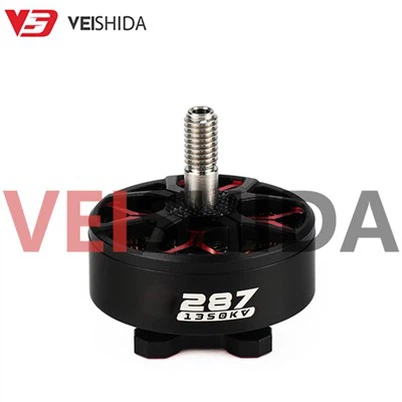
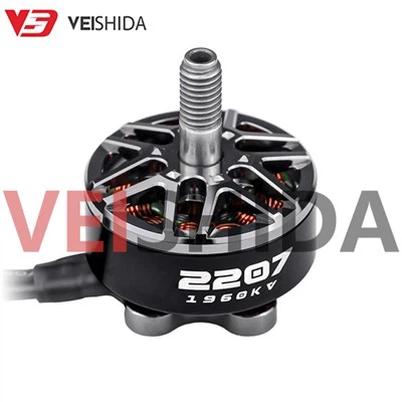
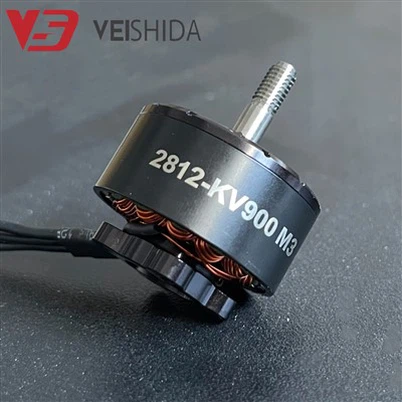
If you are looking for high-performance, stable and reliable motor solutions for different types of drones, VSD provides multiple models of brushless outer rotor motors, covering a wide range of application needs from light cross-country drones to heavy-load aerial photography and agricultural platforms.
VSD hot-selling motor models at a glance:
|
model |
KV value range |
Recommended Uses |
Maximum thrust |
|
380KV |
Industrial-grade aerial photography/multi-rotor logistics platform |
9034g |
|
|
420KV |
Agricultural drones/inspection drones |
7232g |
|
|
900–1520KV |
Medium-sized surveying, aerial photography and load-bearing flight platform |
4185g |
|
|
1300–1950KV |
Medium load aerial photography and training aircraft |
2910g |
|
|
900KV |
Endurance multi-rotor, stable flight platform |
2710g |
|
|
1350–1750KV |
Flexible multi-axis platform, environmental inspection |
2728g |
|
|
1800–2400KV |
Cross-country drones, racing drones |
1683g |
|
|
1960KV |
Lightweight FPV, entry-level aircraft |
1702g |
Why choose VSD motors?
A variety of KV customization options to match different voltage platforms (3S~12S)
Complete test data and performance report for each motor
Before leaving the factory, it has undergone static testing + thrust testing + high temperature aging verification
Can provide ESC matching suggestions, propeller adaptation, OEM/ODM services
Need detailed specifications or technical advice? Feel free to contact us for product manuals, samples, or technical consultation. We also support project collaboration.