

What is the principle and structure of the brushless motor controller?
Leave a message
As a kind of synchronous motor, the rotation speed of its rotor is affected by the speed of its stator rotating magnetic field and the number of rotor poles. DC brushless motor not only has the advantages of simple structure, reliable operation and convenient maintenance, but also has many advantages of high operation efficiency and good speed regulation performance. The most important part of the DC brushless motor is its control structure, its drive can control the rotor to maintain at a certain speed, the performance is more stable. DC brushless motor is a kind of small power motor using electronic conversion. DC brushless motor is widely used in modern production equipment, instrumentation, computer peripheral equipment and household appliances.
Brushless DC motor is composed of motor and driver, is a typical electromechanical integration product. Because the brushless DC motor runs in automatic type, it will not add another start winding on the rotor like the synchronous motor under variable frequency speed regulation, and will not produce oscillation and loss of step when the load changes. The permanent magnet of brushless DC motor of low-and medium-capacity now uses rare earth NdFEb (Nd-Fe-B) material. Therefore, the volume of the rare earth permanent magnet brushless motor is reduced by one seat number compared with the three-phase asynchronous motor with the same capacity.
The brushless DC motor uses the semiconductor switching device to realize the electronic switching direction, that is, the electronic switching device replaces the traditional contact commutator and brush. It has the advantages of high reliability, no directional spark and low mechanical noise, and is widely used in high-grade recording seat, video recorder, electronic instruments and automatic office equipment. The brushless DC motor is composed of a permanent magnet rotor, a multipole winding stator, a position sensor, etc. Position sensing according to the change of the rotor position, the current of the stator winding along a certain order (that is, detect the position of the rotor pole relative to the stator winding, and determine the position of the position sensing signal, after the signal conversion circuit to control the power switch circuit, winding current switching according to a certain logical relationship). The operating voltage of the stator winding is provided by an electronic switch circuit controlled by the position sensor output.

There are three types of position sensors: magnetic, photoelectric and electromagnetic. The brushless DC motor with magnetic position sensor (such as Hall element, magnetic diode, magnetic diode, magnetic resistance device or special integrated circuit, etc.) is installed on the stator component to detect the magnetic field changes generated by the rotation of permanent magnet and rotor. The brushless DC motor using the photoelectric position sensor, the photoelectric sensor is configured in a certain position on the stator component, the rotor is equipped with a shading plate, and the light source is a light-emitting diode or a small bulb. When the rotor rotates, due to the action of the shading, the photosensitive components on the stator will intermittently generate pulse signal at a certain frequency. Brushless DC motor using electromagnetic position sensor, is installed with electromagnetic sensor components (e. g., coupling transformer, proximity switch, LC resonant circuit, etc.), when the position of the permanent magnet rotor changes, the electromagnetic effect will make the electromagnetic sensor produce high frequency modulation signal (the amplitude changes with the rotor position).
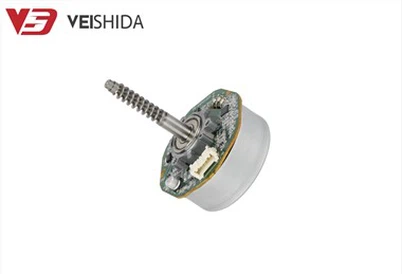
Structurally, the brushless motor and the brushed motor have similarities, and the rotor and stator, but the structure of the brushed motor is a coil winding, connected to the power output shaft, the stator is permanent magnet magnetic steel; the rotor of the brushless motor is permanent magnet magnetic steel, connected with the output shaft, the stator is a winding coil, remove the switching brush of the brush motor used to alternately transform the electromagnetic field, so it is called brushless motor, now there is a problem, without the transformation of electromagnetic field, how to make the brushless motor turn?
Relying on change the input to the brushless motor stator coil of current wave alternating frequency and waveform, around the winding coil formed a motor geometric axis rotating magnetic field, the magnetic field drive the rotor on the permanent magnet magnetic steel rotation, the motor performance and the number of magnetic steel, magnetic steel intensity, motor input voltage size, has a lot to do with, because the input is direct current, current needs to electronic governor into 3 ac, also need to receive control signals from the remote control receiver, control motor speed, to meet the needs of the model. In general, the structure of the brushless motor is relatively simple, the real decision of its use performance or brushless electronic governor, a good electronic governor needs to have a single chip microcomputer control programming, circuit design, complex processing process of the overall control, so the price is much higher than the brush motor.
The above is our VSD motor to share with you about the principle and structure of the brushless motor controller expertise. For more information, please contact our professional customer service personnel to answer. Thank you for clicking and watching.