

Hub Motors Change The Future Of Modern Logistics And Service Industries
Leave a message
In recent years, with the rapid popularization of modern logistics and service industries, distribution robots have become an important part of the innovative logistics field. According to market research data, the scale of the global distribution robot market is steadily expanding at an average annual growth rate of about 20%, and even some industry insiders predict that it will have the opportunity to reach 10 billion dollars by 2030. A big driver of this rapid growth is the surge in demand for contactless services in the post-pandemic era. From business centers, campuses to communities, delivery robots are becoming a common "delivery partner" in people's lives, especially in areas such as food delivery and express delivery, showing high efficiency and safety.
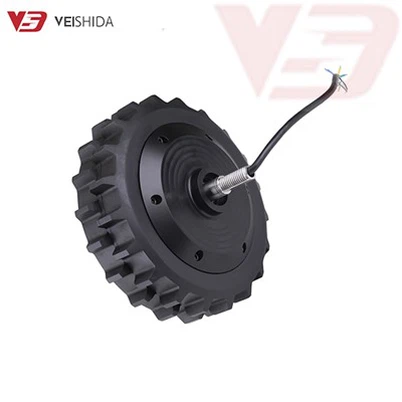
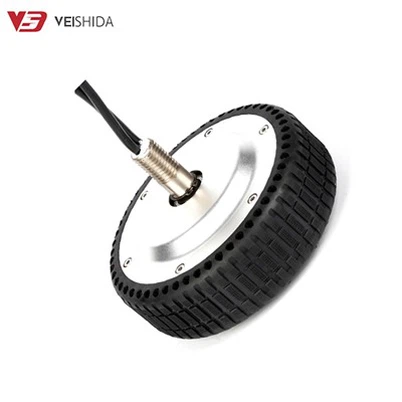
In this wave of delivery robots, Hub Motor plays a crucial role. Because the Hub Motor highly integrates the motor and the hub, the robot structure is more compact, the transmission system is more simple, and the robot can effectively improve the flexibility and control in the narrow space. Compared with the traditional drive system, the direct drive mode of Hub Motor reduces the loss of intermediate transmission components, provides an efficient and low noise operating environment, which is very in line with the needs of distribution robots in noise sensitive areas such as cities and business districts. In addition, it also has the advantage of high torque output, which enables the robot to maintain stable drive performance when the load increases. As a result, Hub Motor has gradually become the ideal drive choice for applications such as modern delivery robots, especially food delivery robots.
What is a Hub Motor?

Hub Motor is a drive system that integrates the motor directly into the inside of the wheel, with the rotor of the motor mounted directly inside the hub of the wheel, thereby directly driving the wheel to rotate. Unlike traditional drive systems, it does not have complicated transmissions, gears or belts, enabling efficient power transmission through a simple structure. This enables it to provide a more compact and lightweight design in the distribution robot, and reduces wear on the mechanical transmission part, improving the durability and efficiency of the whole machine.
Note: Learn about hub motors in more detail
Comparison with conventional drive systems
Hub motors offer a number of unique advantages over traditional gear Motor drives, belt or chain drives, differential drives, and central drive systems:
Gear motor drive system: The traditional gear motor system is usually composed of a motor, a reducer and a gear. Although this system is excellent at improving torque output, its more complex construction also increases the overall weight and volume. In contrast, the Hub Motor eliminates the need for additional gears, reducers and drive shafts, making the entire transmission system simpler, the robot more compact, and the weight is effectively reduced.
Belt or chain drive systems: Belt or chain drive systems are often used in traditional mechanical drives to convert the rotation of the motor into the movement of the wheels through the belt or chain. The disadvantages of such systems are that they are prone to wear and tear, are expensive to maintain, and the transmission efficiency may be reduced due to friction loss. In contrast, the Hub Motor's direct drive method eliminates the intermediate transmission part, greatly improving transmission efficiency and reducing maintenance needs.
Differential transmission systems: Commonly found in four-wheel drive robots, differential systems are used to adjust the difference in speed of individual wheels to ensure steering stability. The differential drive system requires more mechanical components and complex control systems, while the Hub Motor achieves more precise and efficient control by configuring independently driven motors on each wheel, avoiding the problem of multiple drive components working in coordination in traditional differential systems.
Central drive system: The central drive system uses a central motor to drive each wheel, and this structural design is more common in light robots. Its disadvantage is that the drive motor needs to be connected to each wheel through the drive shaft, which increases the mechanical loss and the complexity of the transmission system, which appears to be insufficient power and low control accuracy. Hub Motor directly acts on the wheel through the motor, avoiding this problem, and makes the robot more flexible and adaptable.
Customization options: Tailored to your needs
Another notable feature of Hub Motor is that the customization options are very rich, according to the needs of different distribution robot applications, Hub Motor can provide a variety of customization options to ensure that its performance meets the requirements of specific scenarios. Here are some common customization options:
Gear customization: Hub Motor gear ratios can be adjusted as needed to optimize power and speed. For robots that require high torque output, a lower gear ratio can provide more thrust; While for robots that need to travel at high speeds, a higher gear ratio can be selected to achieve higher speeds.
Power and speed: According to the working environment and load requirements required by the distribution robot, the power of the Hub Motor can be customized. For robots with light load and short distance distribution, low power motor can meet the demand; And for delivery robots that need to run for a long time and large loads, higher power motors are needed to ensure stability and efficiency.
Torque: The torque of the Hub Motor is one of its core performance indicators. According to the design requirements of the distribution robot, the torque of the motor can be tailored. The high torque output can ensure that the robot can still run smoothly on ramps or under load conditions, which is especially suitable for various unexpected situations that the food delivery robot needs to deal with.

VSD is a professional manufacturer of Hub motors
As a professional Hub Motor manufacturer integrating design, production and sales, VSD is committed to providing high-quality motor solutions to customers around the world. We supply directly from the manufacturer, eliminating the middleman link, can provide you with competitive prices, so that your products have more market advantages. We have a modern production factory located in Guangdong, China, with a production area of more than 10,000 square meters, equipped with advanced automated production lines and testing equipment, with more than 500 professional team, superb technology and strict production management to ensure the high quality of each type of motor. You can visit our factory online or offline to witness our production process, ensuring that every link is transparent, reliable and trustworthy.
VSD has passed ISO 9001:2015, IATF16949:2016, ISO 14000 and other international quality management system certifications, and strictly controls every production detail. We are also equipped with advanced testing equipment to ensure that every type of motor has passed strict quality testing before leaving the factory and meets international standards. Our production process and quality control are at the leading level in the industry to ensure that every motor can provide stable and efficient drive support for your robot.
In addition to high quality standard products, VSD also supports custom design and provides OEM and ODM services. According to the needs of our customers, we can tailor the motor model to suit your specific application, offering flexible customization options including gears, power, speed, torque and more to help you create a unique distribution robot solution. We support multiple modes of transportation and provide a complete customs declaration service to ensure that your orders can be smoothly and efficiently delivered to all parts of the world, so that your needs are met in a timely manner.
Note: Learn more about the capabilities of VSD hub micromotor manufacturers
Looking to the Future
With the continuous advancement of Motor technology, the application of Hub Motor in distribution robots will usher in a more efficient and intelligent future. With the improvement of motor efficiency and the reduction of cost, the distribution robot can maintain high efficiency work for a longer period of time, extend battery life and improve distribution efficiency. In the future, Hub Motor will not only improve the operational efficiency and stability of the robot, but also promote the robot to perform tasks in more complex environments by combining with more advanced battery technology. In addition, with the introduction of an intelligent control system, Hub Motor will be able to accurately adjust the drive mode, adapt to different ground conditions or obstacles in real time, and achieve more accurate path planning and load distribution.
In the future, with the further reduction of costs, Hub Motor will become a more popular core drive system in distribution robots. According to market forecasts, by 2030, the global distribution robot market will have the opportunity to reach tens of billions of dollars, and the market demand for Hub Motor will also grow. More and more logistics companies, catering enterprises and commercial institutions will choose the distribution robot equipped with Hub Motor to improve operational efficiency, reduce labor costs, and achieve more intelligent and environmentally friendly services.