

How 25,000 Humanoid Robots in Six Months Reshape Motor Supply
Leave a message
IDC counted close to 25,000 humanoid robots shipped worldwide in the first half of 2026, up 432.1 per cent on the same period last year, with the market worth more than USD 740 million. Counterpoint's tally had already passed 30,000 units by August. The category has stopped being a demonstration programme, and the small motors inside it have turned into a supply question.
What the two counts actually say
IDC's report covers six months and puts a value on them: 25,000 units, up 432.1 per cent, and USD 740 million of market value, up 322.7 per cent. China accounted for more than 19,000 of those units, up 426.3 per cent, or roughly 77.9 per cent of the global total, and Chinese vendors supplied more than 95 per cent of all shipments.
Counterpoint counts the year to date rather than a fixed half-year window, and has the total above 30,000 by August 2026. Agibot took roughly 9,700 units and just over 43 per cent share, Unitree shipped more than 7,000 for 31 per cent, and the top two vendors therefore hold about three quarters of the market between them. The two sets of numbers differ on timing and scope rather than direction.
Why the joint count matters more than the robot count
A humanoid robot does not contain one motor. It contains hands, wrists, elbows, shoulders, a neck and ankles, and every one of those is a separate small motor problem with its own duty cycle, its own envelope and its own reduction requirement.
Those joints ask for three things at once: start and stop quickly, hold a position without hunting, and stay quiet enough to sit next to a person. That is the operating regime where a coreless or slotless rotor has an advantage, because there is no iron in the rotor to cog against the magnets or to be magnetised on every revolution, and the inertia resisting a command is lower.
So demand does not scale with the number of robots. It scales with robots multiplied by actuated joints, and that second number rises every time a hand gains a degree of freedom. This is the part of the forecast that gets missed when a shipment figure is read as a motor figure.
What it changes on the supply side
Three things shift when a motor line starts feeding robot assembly instead of a single appliance programme.
The first is model count. One platform can call for four or five windings in the same frame, each with a different lead length, connector or shaft, so the constraint stops being unit price and becomes changeover time.
The second is consistency. A robot carrying dozens of motors is calibrated as a system, so a torque constant that drifts between batches turns into re-calibration work on the customer's line rather than a rejected part at goods-in.
The third is traceability. Robot programmes tend to audit their suppliers, and the questions are about process control, batch records and change notification rather than about the numbers on the datasheet.
Where to look in our range
The joints above are direct-drive problems. Direct drive in a small envelope means an outrunner: the magnets sit on a bell that turns with the load, and there is no gear stage between the motor and the joint. That is the construction we build in the largest volume, and it is documented frame by frame in the drone motor range - the same architecture, sized for propellers rather than wrists, which makes those pages the closest open reference we have for how the winding and bearing choices behave in the field.
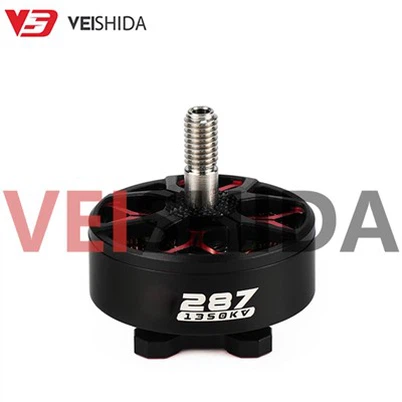
The 5315 380KV outrunner is the large-propeller end of that line: low KV, high torque per amp, a bell that carries real inertia. The 2306 FPV brushless motor is the small, high-KV end, where the whole frame weighs less than the connector on a joint motor and the response is measured in milliseconds. Between them they bracket the size range a hand or a wrist actually needs.
The windings differ from what a joint motor would take, but the construction and the quoting method are the same: speed, torque at that speed, supply and envelope. If the joint needs torque at low speed rather than speed at low torque, an outrunner alone will not do it, and the honest answer is a geared frame rather than a bigger bell. We will say so rather than sell an outrunner into a job it cannot do. The rest of the drone motor range is laid out by prop size if you want to see how the frames scale.
We build motors in Shenzhen, hold ISO9001:2015 and IATF16949, and quote against a drawing rather than a catalogue page.